Gah. I am exhausted. Who knew that bugs and pumpkins and chili could take so much out of a guy?
Actually, now that I read that, it sounds really ... wrong. Sorry.
So, I promised you a review of Mark Charan Newton's Nights of Villjamur, and here it is.
I said, on Friday, that the book was solidly good, but not excellent. First off, Newton is treading some well trodden ground here. We have an empire on a world which is about to enter into an ice age. Everyone knows that the ice age is coming, and the empire has been preparing for the coming disaster. So - empire in danger; we've seen that before. An ice age - not a common disaster, but not unheard of. There are forces within the empire which seek to turn the disaster to their own ends - in particular, there is a conspiracy attempting to overthrow the Emperor. This produces lots and lots of nice politics - but political plots are a dime a dozen. We have a detective who stumbles onto the conspiracy while doing an investigation of the mysterious death of a council member. Ok, a police procedural. Plus, there's a romance plot involving the sister of the Empress (the Emperor throws himself off a balcony a couple of chapters in. This isn't my spoiler - it's on the book flap) and the man she thinks she's hired to teach her dancing and sword fighting. (There's a fair bit of mistaken identity throughout the book.) There's a military plot involving a variety of threats, including zombies and giant crab-like monster things. There are cultists who accumulate relics, which seem to be clearly some sort of advanced technology - perhaps the remnants of an earlier, much more advanced, society? So, not only is Newton treading ground that has been trodden before, but he is also treading it in many many different directions. All of these plots do blend together, somewhat, but the whole left me a little baffled and breathless. I felt like saying, "damn it, man, pick one and follow it through!"
The police procedural worked as the central piece of the book, and it was clearly the most complete element. It had a defined beginning, middle, and end. However, it was a "we, the reader, know more than the detective does" sort of procedural - and I don't like those. Also, I felt that the mystery was a little weak in other ways too, chiefly motivation for the murderer. Additionally, the police bit featured a particularly nasty bit of betrayal - good writing, but uncomfortable. That was an odd bit where an excellent piece of writing made me not really like a whole bit of plot - weird.
The politics were the best part of the novel. I really like political novels, and the politics here were murky and twisty - exactly the sort of thing I like. The motivation for the villain here was clear as a bell - in order to take over as Emperor, he needs to remove the existing dynasty. Watching him plot was delightful, and he was an excellent villain. If he had a mustache, he would have twirled it. Jeremy Irons could easily play him in the film adaptation, and chew scenery to his heart's content. Seeing him get his comeupance will be delightful.
Newton's characters in general are really well written. Given the extent that this is a character driven novel, that's a good thing. Poorly written characters would have doomed this novel. Newton offers us a broad cast that we can care about. We can root for the cocky young sword and dance instructor learning to love for the first time, or for the young rulers learning that there is more to their empire than the palace they grew up in. We can watch the slow re-building of the relationship between the detective and his estranged wife. We can thrill to the exploits of the military commander facing unfaceable odds. We can ponder the motives of mysterious cultists, engaged in byzantine plots of their own imagining. All of these myriad characters make the book worth reading, and compensate many many times for the problems I've mentioned.
The other thing that Newton does that I found interesting (and also frustrating). The empire has several different species in it - humans, and Rumels (who are bipedal, mammalian, furred, have tails, and are very long lived), and Guaradas (who are bird type things), and possibly other things hiding in the wings. All of these different species of character make for some interesting dynamics - how does it all fit together?
The frustrating thing about these alien species is that Newton never really explains how it all fits together, or where the various species came from, or offer us a glossary or a "history" of the Empire - the bits that might, tacked onto the end of a book like this, fill in the gaps that a reader like me really craves. There isn't even a map of the empire, or a suggestion of how large it is, relative to the world it's on. Perhaps a map would spoil a big reveal in a future book - "ha ha! Look, they're really on Earth!" - but given the distances people were travelling between islands, and the suggestion that there are hostile forces just outside the empire - I wanted a map. These are little things, but they accumulate.
My final complaint about the book is that it doesn't end satisfyingly. It's clear that Newton is writing an Epic (I feel some justice in using the term, because deities do play a role in the novel, if not directly), and so the novel ends somewhat abruptly, just as the conspiracy plot comes to fruition in one place, and the heroic military expedition is retreating from sure and certain death in another place. I know the second book has been published (because it was seeing Book 2 which prompted me to pick up Book 1), and I'm not opposed, per se, to a serial narrative - but, on top of the other little things ... Well. The strong characters will draw me back into the second book, but it will be a "pick up when I see it" rather than a "hunt it down because I must have it" type thing.
Sunday, October 30, 2011
Friday, October 28, 2011
Friday Review Place Holder
Hey guys,
I did read a book this week - Mark Charon Newton's Villjamur Nights. It was a solidly good novel - not excellent, for some reasons that I'll elaborate on - and it was dense and took all week to read. But I can't tell you about it right now, because I have to leave to pick up the baby from day care, and I may not be able to tell you about it later because the big kid has a Halloween party to go to. I don't know that I'll be able to tell you about it tomorrow, either, because I'm being dragged off to Ithaca to look at bugs, and then to a pumpkin farm to look at pumpkins (and candy apples! And donuts! Can't forget the donuts!), and then to a different Halloween party. I might be able to write about it on Sunday. We shall see. Meantime, here's a place holder, and some questions for discussion. What plans do you have for All Hallows Eve? Are you dressing up? If so, what as? Are you going out (to a party or to collect candy), or are you staying in to give out candy? Tell me, because I really want to know!
I did read a book this week - Mark Charon Newton's Villjamur Nights. It was a solidly good novel - not excellent, for some reasons that I'll elaborate on - and it was dense and took all week to read. But I can't tell you about it right now, because I have to leave to pick up the baby from day care, and I may not be able to tell you about it later because the big kid has a Halloween party to go to. I don't know that I'll be able to tell you about it tomorrow, either, because I'm being dragged off to Ithaca to look at bugs, and then to a pumpkin farm to look at pumpkins (and candy apples! And donuts! Can't forget the donuts!), and then to a different Halloween party. I might be able to write about it on Sunday. We shall see. Meantime, here's a place holder, and some questions for discussion. What plans do you have for All Hallows Eve? Are you dressing up? If so, what as? Are you going out (to a party or to collect candy), or are you staying in to give out candy? Tell me, because I really want to know!


Wednesday, October 26, 2011
Wednesday Library Post, 10/26/2011
This is the post I should have made yesterday. It is perhaps indicative of something that my immediate reaction, upon opening the blog and seeing my OWS post from last Friday, was "oh, crap, did I forget to post a review last week?" I'm not sure what it's indicative of, but it's indicative of something.
Anyway. The big kid was away on a field trip yesterday, so the baby and I trundled off to a different library (because that branch had a book I was specifically looking for - Sandry's Book, by Tamora Pierce. Which I am reading to the big kid.) I do like to check out different libraries in my local system - different librarians have different acquisition polices, so there are different books at different branches.
Anyway, two books yesterday:
Jim Butcher - White Night
This is somewhere near the middle of the Harry Dresden "wizard in Chicago" series. Today, I tested the possibility of playing in a Harry Dresden role playing game via skype - it seemed to work. I grabbed this book in the thought that I should probably continue my reading. Plus, I really like Harry Dresden.
Nnedi Okorafor - Who Fears Death
I have had this book before, but did not manage to get to it before it had to go back. It's post-apocalyptic sci-fi, set in Africa, with a strong African flavor. It's billed as "magic realism." I recall it was featured in Scalzi's "Big Idea" series, which is why I grabbed it in the first place. It's fairly chewy, in terms of plot and writing style - luckily, I have some lighter stuff to read first.
Anyway. The big kid was away on a field trip yesterday, so the baby and I trundled off to a different library (because that branch had a book I was specifically looking for - Sandry's Book, by Tamora Pierce. Which I am reading to the big kid.) I do like to check out different libraries in my local system - different librarians have different acquisition polices, so there are different books at different branches.
Anyway, two books yesterday:
Jim Butcher - White Night
This is somewhere near the middle of the Harry Dresden "wizard in Chicago" series. Today, I tested the possibility of playing in a Harry Dresden role playing game via skype - it seemed to work. I grabbed this book in the thought that I should probably continue my reading. Plus, I really like Harry Dresden.
Nnedi Okorafor - Who Fears Death
I have had this book before, but did not manage to get to it before it had to go back. It's post-apocalyptic sci-fi, set in Africa, with a strong African flavor. It's billed as "magic realism." I recall it was featured in Scalzi's "Big Idea" series, which is why I grabbed it in the first place. It's fairly chewy, in terms of plot and writing style - luckily, I have some lighter stuff to read first.
Friday, October 21, 2011
OWS and Libraries
A New York Times article about the library that Occupy Boston has set up. Hopefully you'll still be able to read the article - I'm not sure what NYT's paywall system is like.
Friday Review Post, 10/21/2011
I wish to note, should I not finish this this evening, that I am actually sitting down to write it on Friday.
Four books this week.
First up, I found that I could not resist the allure of:
Simon Garfield - Just My Type
This is a book about fonts. It is, perhaps to some, surprising in its goodness. Garfield presents a history of fonts from Gutenberg to the present. He also highlights several specific fonts in a series of "font breaks" - interstitial chapters devoted to several fonts (plus one on the interobang, which Garfield describes as the Esperanto of fonts - something which clearly needs to exist, and yet which no one actually wants to use). Each of the font breaks features the font in question in the first paragraph of the break, which is a nice touch.
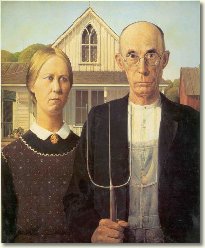
Fonts, it turns out, are fascinating. At least to me, anyway. This kinda fits into my existing experience of things I find neat. I took a class on material culture (the history of objects - using objects as primary sources. Archaeology for historians, perhaps), and since then have been noticing architectural elements in my built environment - particularly the American Gothic window (not the painting - the iconic architectural style for which the painting is named - the house behind the couple has an American Gothic window in its peak.) and the Mansard Roof.
Fonts, it turns out, are the same for me - having read the book, I'm finding myself noticing fonts a lot more. Which is neat, but also a little frustrating. This would seem to be one of those cases in which ignorance is, actually, bliss. I ... I had dreams about fonts as I was finishing the book. Which is just, frankly, odd. I - guys, I changed the fonts on the computer. All of my icons, all of the tags at the top of my browser, the URL, even the clock on my desktop - all are now in Poor Richard font. Because it's pretty. (especially the ampersand! Did I mention that there's a whole chapter on ampersands? There is!) This is, perhaps, not healthy.
Case in point - My new favorite font? Doves. Which doesn't exist. Because the designer, Thomas Cobden-Sanderson, was so obsessed with the idea that lesser type setters than himself would use his typeface for projects to which it was ill fitted that he threw the entire collection of type into the Thames.* I wouldn't have known about the typeface if it weren't for this book - but, given that I can't actually USE the typeface (thanks ever so, Mr. Cobden-Sanderson!), perhaps I would have been better off as a result. Thanks, Mr. Garfield?
*I am not alone in have been struck by the typeface. Here's a lovely essay on the type face, on the nature of beauty, and on why it's a shame that Unitarian Universalists should be less inclined to reject the Bible. There's a lovely image of the first page of the Bible, printed in Doves typeface, in the middle of the essay. Perhaps you'll be captivated too... If so, sorry.
Second book -
Alison Goodman - Eon: The DragonEye Reborn
This book was amazingly good! It had so many things that I like in books. It had a strong female character (although, you know, she spent most of the book pretending to be a guy - more on that in a minute), it was inspired by Asian narratives instead of Western ones (more on that in a minute too), it had a strong transgendered character (who wasn't the main girl-pretending-to-be-a-boy character), it had great heaping gobs of politics, it had dragons (Asian style dragons) - lots and lots of really great stuff. Plus, it was really well written - a plot which just pulled me in and dragged me forward. Over 500 pages, and I finished in in just over a day - simply marvelous story telling.
So, I really really liked the book. But, having finished it, I started pondering. (Actually, that's probably the sign of a really good book, isn't it? It makes you keep thinking about it after the fact?) I pondered two things. First, I had just had a conversation with a friend about how we wished there were more fantasy/sci-fi books based on narratives traditions other than the Western tradition. I mentioned Lloyd Alexander's The Iron Ring, which is set in India, but we really couldn't think of many books where a strong non-Western tradition informed the story. So, I was excited by this book, because it is clearly inspired by Asian traditions. But, when I started thinking about it, I didn't have a strong impression of the characters as Asian. Which makes me wonder - to what extent is that my fault as a product of white privilege (characters in books, unless clearly denoted otherwise, default to white, because I, the reader, am white, and I assume that the characters look like me), and to what extent is that Goodman's fault in that she didn't denote the characters as Asian? Which, what more could she have done? I mean, the book is clearly set in an Asian background - why am I seeing Eon/a as white? So, question to ponder: how can an author denote a character as non-white without hammering the reader over the head with the character's non-whiteness? To what extent should the author be responsible for doing this anyway?
So, that got me pondering the gender tropes in the novel. Gender and gender identity are a big deal in this book. Eon/a is masquerading as a boy because the position she aspires to, Dragoneye, can only be held by a male. This, ultimately, becomes a major plot point, as Eon/a is forced to make a decision regarding her gender presentation - I think I can say that without spoiling anything. Beyond that, however (because "girl pretends to be boy" is an ancient plot device - look at Shakespeare, for instance), Eon/a interacts extensively with a eunuch, Ryko, who is recognized as serving a male role in society (forcing consideration of what it means to be male - how much of it is biology, and how much of it is performative?) and a transgendered individual, Lady Dela (a male to female trans). Dela forces Eon/a to confront her own sense of gender, and in the end (and, again, I hope this doesn't spoil anything) Eon/a is forced to make a decision between being Eon and being Eona. Dela's strong sense of who she is, regardless of biological gender, aids Eon/a in making her decision.
Dela, I think, is an excellent character. She's fully rendered, with a realistic approach to her situation. Goodman indicates that Dela has not merged seamlessly into the society she inhabits - she has been attacked for her nature. She also has Eon/a ask Dela if Dela has ever considered surgery (Dela has). Eon/a experiments (for magical reasons) with some drugs which enhance and/or diminish various elements of her gender identity (it's magic, and magic works differently depending on your gender in Goodman's world - this is internally consistent, even if I'm not explaining if properly). My overwhelming impression is that Goodman has done an excellent job depicting issues of gender, and transgender. Moreover, she has done it without making those aspects the entirety of the characters in question - these are fully realized people.
At least, that was what I thought when I finished the book. But my musings on racial identity forced me to wonder how well equipped I, a cisgendered male, am in assessing these things. So I went looking for a review from a transgenered point of view. I found this essay, which seems to agree with me re: Dela, but suggests that Eon/a is more troublesome, gender-wise. I'm not sure that I fully agree with the final assessment (that Eon/a plays with gender for reasons of convenience - I think it's deeper than that), but the essay gave me some food for thought. That being said, I remain convinced that Goodman has done something significant with her portrayal of Lady Dela. Dela doesn't quite approach the stage of being trans just because she's trans** - her transgendered nature serves the plot, and the character would not work in her role as anything other than trans - but it's certainly a good first step.
One significant complaint - the book doesn't end. Instead, it clearly leads into the sequel (Eona). However, since I really really want to read more, and since I know the sequel exists (I'm not going to be left hanging), I'm willing to forgive, just this once.
Highly recommended to anyone who likes really well written YA fantasy.
** We never ask "why is this character straight or white?" Indeed, we assume, unless otherwise indicated, that a character is straight and white, even if there is no clear reason to think so. Thus, the ideal situation, vis a vis a minority character, is for the reader to be willing to accept them as trans, or gay, or a person of colour, without wondering why they have been written that way. This, of course, requires a change on the part of the author/publisher, but also (and more difficult to achieve, I think) on the part of the reading public in general.
After two hefty novels which gave me deeply complex dreams and ponderings, I wanted something a little lighter, so I went with
John Sandford - Bad Blood
First up, a great big trigger warning on this book, and possibly the review - the book is about ritual sexual abuse, including rape and incest. There aren't significantly graphic presentations of this abuse, but there are several scenes with fairly hefty implications. Those aren't things which a triggering for me, and I found places in the book where it was hard to continue. So, you have been warned.
Sandford, as you know, is a guilty pleasure of mine. The plots are fairly straightforward. The good guys are good - they sometimes bend the law a little (a judicious use of judicial wrangling to ensure that critical evidence ends up in the right place at the right time - that sort of thing), but they never break it completely. Plus, the bad guys are so clearly bad that some bending feels kosher. (even though, on an intellectual level, I register that it isn't.) Sandford doesn't push any of my personal buttons - his villains are villains for individual reasons, and not because they belong to a particular racial and/or religious group. That is, Sandford sometimes writes black villains, or gay villains, or Arabic villains, but they are villains because of what they do, not because they are black, gay, or Arabic. His cops seem willing to accept different genders, different sexual orientations, different races, and different religious views, provided that those elements don't get in the way of doing their job. His characters are reasonably well written, and the plots are hook-y enough that, if you like the sort of stories he's telling, you don't mind that the characters are only reasonably well written. I feel like I'm defending my literary choices - I guess I am. I know that the books are trashy; that's why I read them.
Anyway, Virgil "that fuckin'" Flowers is called in to look at a suspicious prison cell suicide, which turns into a multiple murder investigation, which uncovers a deep, and deeply sordid, local secret involving a local religious sect which uses sex in its idiosyncratic version of Christian worship. The whole thing ends, as this sort of story often does, with fire, and blood, and highly trained psychological counselors.
The only musing this book prompted was some thought on the nature of police procedurals, and the possibility that there are two sorts: one where we follow the detective as he plods through clues, and thus unravel the crime at the same rate as he does; and one where we, the readers, have a clearer sense of what's actually happening than the detective, and so we get to watch him piece the bits together in such a way that he arrives at the place that we've already seen. I know Sandford writes both kinds, and I greatly prefer the former type. This book was decidedly the latter, alas. That, and the dreadful subject matter, kinda left a bad taste in my mouth.
Finally, a rare graphic novel:
M.K. Reed and Johnathan Hill - Americus
This was a book clearly written more or less exactly for me. It tells the story of an attempt to remove a series of books from a small town library. The books tell the story of Apathea Ravenchilde, who is a witch. A conservative Christian group decide that the books are having a negative effect upon their children (with no evidence of this, naturally) and decide that they have to be removed from the library. The main plot focuses on this struggle, with Neal Barton (young reader, and library page) and Charlotte Murphy (youth librarian) organizing the champions of the library.
The book is also about Neal's transition into high school, without his best friend, who has been sent to military school because he is caught reading an Apathea Ravenchilde novel. Neal feels true to me - awkward teen in a somewhat foreign environment, trying to figure out who he is and how he will make his way in the world. Yeah, I identify with him.
The book also features snippets of the Apathea story. These, oddly enough, seem more realistically drawn than the drawings of "reality" - very interesting.
It's a black and white comic. The art is excellent, I found the lettering a little tough to read, but that may have been the light and the tired conspiring against me. A great book for anyone working on growing up (especially if they are awkward teens who like to read fantasy), and anyone who loves libraries. Here's a poster that Hill and Reed did for Banned Book Week - you can find the original here:
Look at that - it's only just 11 pm, and I'm done. I can post reviews on a Friday, I really really can!
Four books this week.
First up, I found that I could not resist the allure of:
Simon Garfield - Just My Type
This is a book about fonts. It is, perhaps to some, surprising in its goodness. Garfield presents a history of fonts from Gutenberg to the present. He also highlights several specific fonts in a series of "font breaks" - interstitial chapters devoted to several fonts (plus one on the interobang, which Garfield describes as the Esperanto of fonts - something which clearly needs to exist, and yet which no one actually wants to use). Each of the font breaks features the font in question in the first paragraph of the break, which is a nice touch.
 |
| This is an interobang |
Fonts, it turns out, are the same for me - having read the book, I'm finding myself noticing fonts a lot more. Which is neat, but also a little frustrating. This would seem to be one of those cases in which ignorance is, actually, bliss. I ... I had dreams about fonts as I was finishing the book. Which is just, frankly, odd. I - guys, I changed the fonts on the computer. All of my icons, all of the tags at the top of my browser, the URL, even the clock on my desktop - all are now in Poor Richard font. Because it's pretty. (especially the ampersand! Did I mention that there's a whole chapter on ampersands? There is!) This is, perhaps, not healthy.
Case in point - My new favorite font? Doves. Which doesn't exist. Because the designer, Thomas Cobden-Sanderson, was so obsessed with the idea that lesser type setters than himself would use his typeface for projects to which it was ill fitted that he threw the entire collection of type into the Thames.* I wouldn't have known about the typeface if it weren't for this book - but, given that I can't actually USE the typeface (thanks ever so, Mr. Cobden-Sanderson!), perhaps I would have been better off as a result. Thanks, Mr. Garfield?
Anyway, if you are geekily inclined - that is, inclined to take odd things entirely too seriously - this book might tickle your fancy. If you are already a font geek - and you know you're out there - this is a must read.
*I am not alone in have been struck by the typeface. Here's a lovely essay on the type face, on the nature of beauty, and on why it's a shame that Unitarian Universalists should be less inclined to reject the Bible. There's a lovely image of the first page of the Bible, printed in Doves typeface, in the middle of the essay. Perhaps you'll be captivated too... If so, sorry.
Second book -
Alison Goodman - Eon: The DragonEye Reborn
This book was amazingly good! It had so many things that I like in books. It had a strong female character (although, you know, she spent most of the book pretending to be a guy - more on that in a minute), it was inspired by Asian narratives instead of Western ones (more on that in a minute too), it had a strong transgendered character (who wasn't the main girl-pretending-to-be-a-boy character), it had great heaping gobs of politics, it had dragons (Asian style dragons) - lots and lots of really great stuff. Plus, it was really well written - a plot which just pulled me in and dragged me forward. Over 500 pages, and I finished in in just over a day - simply marvelous story telling.
So, I really really liked the book. But, having finished it, I started pondering. (Actually, that's probably the sign of a really good book, isn't it? It makes you keep thinking about it after the fact?) I pondered two things. First, I had just had a conversation with a friend about how we wished there were more fantasy/sci-fi books based on narratives traditions other than the Western tradition. I mentioned Lloyd Alexander's The Iron Ring, which is set in India, but we really couldn't think of many books where a strong non-Western tradition informed the story. So, I was excited by this book, because it is clearly inspired by Asian traditions. But, when I started thinking about it, I didn't have a strong impression of the characters as Asian. Which makes me wonder - to what extent is that my fault as a product of white privilege (characters in books, unless clearly denoted otherwise, default to white, because I, the reader, am white, and I assume that the characters look like me), and to what extent is that Goodman's fault in that she didn't denote the characters as Asian? Which, what more could she have done? I mean, the book is clearly set in an Asian background - why am I seeing Eon/a as white? So, question to ponder: how can an author denote a character as non-white without hammering the reader over the head with the character's non-whiteness? To what extent should the author be responsible for doing this anyway?
So, that got me pondering the gender tropes in the novel. Gender and gender identity are a big deal in this book. Eon/a is masquerading as a boy because the position she aspires to, Dragoneye, can only be held by a male. This, ultimately, becomes a major plot point, as Eon/a is forced to make a decision regarding her gender presentation - I think I can say that without spoiling anything. Beyond that, however (because "girl pretends to be boy" is an ancient plot device - look at Shakespeare, for instance), Eon/a interacts extensively with a eunuch, Ryko, who is recognized as serving a male role in society (forcing consideration of what it means to be male - how much of it is biology, and how much of it is performative?) and a transgendered individual, Lady Dela (a male to female trans). Dela forces Eon/a to confront her own sense of gender, and in the end (and, again, I hope this doesn't spoil anything) Eon/a is forced to make a decision between being Eon and being Eona. Dela's strong sense of who she is, regardless of biological gender, aids Eon/a in making her decision.
Dela, I think, is an excellent character. She's fully rendered, with a realistic approach to her situation. Goodman indicates that Dela has not merged seamlessly into the society she inhabits - she has been attacked for her nature. She also has Eon/a ask Dela if Dela has ever considered surgery (Dela has). Eon/a experiments (for magical reasons) with some drugs which enhance and/or diminish various elements of her gender identity (it's magic, and magic works differently depending on your gender in Goodman's world - this is internally consistent, even if I'm not explaining if properly). My overwhelming impression is that Goodman has done an excellent job depicting issues of gender, and transgender. Moreover, she has done it without making those aspects the entirety of the characters in question - these are fully realized people.
At least, that was what I thought when I finished the book. But my musings on racial identity forced me to wonder how well equipped I, a cisgendered male, am in assessing these things. So I went looking for a review from a transgenered point of view. I found this essay, which seems to agree with me re: Dela, but suggests that Eon/a is more troublesome, gender-wise. I'm not sure that I fully agree with the final assessment (that Eon/a plays with gender for reasons of convenience - I think it's deeper than that), but the essay gave me some food for thought. That being said, I remain convinced that Goodman has done something significant with her portrayal of Lady Dela. Dela doesn't quite approach the stage of being trans just because she's trans** - her transgendered nature serves the plot, and the character would not work in her role as anything other than trans - but it's certainly a good first step.
One significant complaint - the book doesn't end. Instead, it clearly leads into the sequel (Eona). However, since I really really want to read more, and since I know the sequel exists (I'm not going to be left hanging), I'm willing to forgive, just this once.
Highly recommended to anyone who likes really well written YA fantasy.
** We never ask "why is this character straight or white?" Indeed, we assume, unless otherwise indicated, that a character is straight and white, even if there is no clear reason to think so. Thus, the ideal situation, vis a vis a minority character, is for the reader to be willing to accept them as trans, or gay, or a person of colour, without wondering why they have been written that way. This, of course, requires a change on the part of the author/publisher, but also (and more difficult to achieve, I think) on the part of the reading public in general.
After two hefty novels which gave me deeply complex dreams and ponderings, I wanted something a little lighter, so I went with
John Sandford - Bad Blood
First up, a great big trigger warning on this book, and possibly the review - the book is about ritual sexual abuse, including rape and incest. There aren't significantly graphic presentations of this abuse, but there are several scenes with fairly hefty implications. Those aren't things which a triggering for me, and I found places in the book where it was hard to continue. So, you have been warned.
Sandford, as you know, is a guilty pleasure of mine. The plots are fairly straightforward. The good guys are good - they sometimes bend the law a little (a judicious use of judicial wrangling to ensure that critical evidence ends up in the right place at the right time - that sort of thing), but they never break it completely. Plus, the bad guys are so clearly bad that some bending feels kosher. (even though, on an intellectual level, I register that it isn't.) Sandford doesn't push any of my personal buttons - his villains are villains for individual reasons, and not because they belong to a particular racial and/or religious group. That is, Sandford sometimes writes black villains, or gay villains, or Arabic villains, but they are villains because of what they do, not because they are black, gay, or Arabic. His cops seem willing to accept different genders, different sexual orientations, different races, and different religious views, provided that those elements don't get in the way of doing their job. His characters are reasonably well written, and the plots are hook-y enough that, if you like the sort of stories he's telling, you don't mind that the characters are only reasonably well written. I feel like I'm defending my literary choices - I guess I am. I know that the books are trashy; that's why I read them.
Anyway, Virgil "that fuckin'" Flowers is called in to look at a suspicious prison cell suicide, which turns into a multiple murder investigation, which uncovers a deep, and deeply sordid, local secret involving a local religious sect which uses sex in its idiosyncratic version of Christian worship. The whole thing ends, as this sort of story often does, with fire, and blood, and highly trained psychological counselors.
The only musing this book prompted was some thought on the nature of police procedurals, and the possibility that there are two sorts: one where we follow the detective as he plods through clues, and thus unravel the crime at the same rate as he does; and one where we, the readers, have a clearer sense of what's actually happening than the detective, and so we get to watch him piece the bits together in such a way that he arrives at the place that we've already seen. I know Sandford writes both kinds, and I greatly prefer the former type. This book was decidedly the latter, alas. That, and the dreadful subject matter, kinda left a bad taste in my mouth.
Finally, a rare graphic novel:
M.K. Reed and Johnathan Hill - Americus
This was a book clearly written more or less exactly for me. It tells the story of an attempt to remove a series of books from a small town library. The books tell the story of Apathea Ravenchilde, who is a witch. A conservative Christian group decide that the books are having a negative effect upon their children (with no evidence of this, naturally) and decide that they have to be removed from the library. The main plot focuses on this struggle, with Neal Barton (young reader, and library page) and Charlotte Murphy (youth librarian) organizing the champions of the library.
The book is also about Neal's transition into high school, without his best friend, who has been sent to military school because he is caught reading an Apathea Ravenchilde novel. Neal feels true to me - awkward teen in a somewhat foreign environment, trying to figure out who he is and how he will make his way in the world. Yeah, I identify with him.
The book also features snippets of the Apathea story. These, oddly enough, seem more realistically drawn than the drawings of "reality" - very interesting.
It's a black and white comic. The art is excellent, I found the lettering a little tough to read, but that may have been the light and the tired conspiring against me. A great book for anyone working on growing up (especially if they are awkward teens who like to read fantasy), and anyone who loves libraries. Here's a poster that Hill and Reed did for Banned Book Week - you can find the original here:
 |
| That would be Apathea on the left, and Neal on the right. Just, you know, FYI. |
Look at that - it's only just 11 pm, and I'm done. I can post reviews on a Friday, I really really can!
Wednesday, October 19, 2011
Tuesday Library Post, early Wednesday Morning, 10/19/2011
A schedule? What's a schedule?
Two books this week:
Frances Fox Piven - Who's Afraid of Frances Fox Piven?
Piven is a professor of sociology and poli sci at CUNY. She's also an advocate for welfare rights and social justice. This is a collection of her essays.
Jon Scieszka, ed. - Guys Read: Thriller
Scieszka is producing a series of anthologies designed to appeal to young male readers, in an effort to raise the young male literacy rate. Given the collection title - "Guys Read" - well, I couldn't pass it up, could I?
Two books this week:
Frances Fox Piven - Who's Afraid of Frances Fox Piven?
Piven is a professor of sociology and poli sci at CUNY. She's also an advocate for welfare rights and social justice. This is a collection of her essays.
Jon Scieszka, ed. - Guys Read: Thriller
Scieszka is producing a series of anthologies designed to appeal to young male readers, in an effort to raise the young male literacy rate. Given the collection title - "Guys Read" - well, I couldn't pass it up, could I?
Tuesday, October 18, 2011
OWS thoughts from Lemony Snicket
via Neil Gaiman: I don't know why the huge gaps are there in the text, but I promise that there IS text there. And it's worth reading. And it's in a pretty font.
1. If you work hard, and become successful, it does not necessarily mean you are successful because you worked hard, just as if you are tall with long hair it doesn’t mean you would be a midget if you were bald.
2. “Fortune” is a word for having a lot of money and for having a lot of luck, but that does not mean the word has two definitions.
3. Money is like a child—rarely unaccompanied. When it disappears, look to those who were supposed to be keeping an eye on it while you were at the grocery store. You might also look for someone who has a lot of extra children sitting around, with long, suspicious explanations for how they got there.
4. People who say money doesn’t matter are like people who say cake doesn’t matter—it’s probably because they’ve already had a few slices.
5. There may not be a reason to share your cake. It is, after all, yours. You probably baked it yourself, in an oven of your own construction with ingredients you harvested yourself. It may be possible to keep your entire cake while explaining to any nearby hungry people just how reasonable you are.
6. Nobody wants to fall into a safety net, because it means the structure in which they’ve been living is in a state of collapse and they have no choice but to tumble downwards. However, it beats the alternative.
7. Someone feeling wronged is like someone feeling thirsty. Don’t tell them they aren’t. Sit with them and have a drink.
8. Don’t ask yourself if something is fair. Ask someone else—a stranger in the street, for example.
9. People gathering in the streets feeling wronged tend to be loud, as it is difficult to make oneself heard on the other side of an impressive edifice.
10. It is not always the job of people shouting outside impressive buildings to solve problems. It is often the job of the people inside, who have paper, pens, desks, and an impressive view.
11. Historically, a story about people inside impressive buildings ignoring or even taunting people standing outside shouting at them turns out to be a story with an unhappy ending.
12. If you have a large crowd shouting outside your building, there might not be room for a safety net if you’re the one tumbling down when it collapses.
13. 99 percent is a very large percentage. For instance, easily 99 percent of people want a roof over their heads, food on their tables, and the occasional slice of cake for dessert. Surely an arrangement can be made with that niggling 1 percent who disagree.
2. “Fortune” is a word for having a lot of money and for having a lot of luck, but that does not mean the word has two definitions.
3. Money is like a child—rarely unaccompanied. When it disappears, look to those who were supposed to be keeping an eye on it while you were at the grocery store. You might also look for someone who has a lot of extra children sitting around, with long, suspicious explanations for how they got there.
4. People who say money doesn’t matter are like people who say cake doesn’t matter—it’s probably because they’ve already had a few slices.
5. There may not be a reason to share your cake. It is, after all, yours. You probably baked it yourself, in an oven of your own construction with ingredients you harvested yourself. It may be possible to keep your entire cake while explaining to any nearby hungry people just how reasonable you are.
6. Nobody wants to fall into a safety net, because it means the structure in which they’ve been living is in a state of collapse and they have no choice but to tumble downwards. However, it beats the alternative.
7. Someone feeling wronged is like someone feeling thirsty. Don’t tell them they aren’t. Sit with them and have a drink.
8. Don’t ask yourself if something is fair. Ask someone else—a stranger in the street, for example.
9. People gathering in the streets feeling wronged tend to be loud, as it is difficult to make oneself heard on the other side of an impressive edifice.
10. It is not always the job of people shouting outside impressive buildings to solve problems. It is often the job of the people inside, who have paper, pens, desks, and an impressive view.
11. Historically, a story about people inside impressive buildings ignoring or even taunting people standing outside shouting at them turns out to be a story with an unhappy ending.
12. If you have a large crowd shouting outside your building, there might not be room for a safety net if you’re the one tumbling down when it collapses.
13. 99 percent is a very large percentage. For instance, easily 99 percent of people want a roof over their heads, food on their tables, and the occasional slice of cake for dessert. Surely an arrangement can be made with that niggling 1 percent who disagree.
Subscribe to:
Posts (Atom)
Subscribe To




 Posts
All Comments
Posts
All Comments