Lauren Willig, The Mischief of the Mistletoe - I like Lauren Willig's Pink Carnation books. They narrate the story of the fictional British spy, the Pink Carnation, and the stories of all the various people who come into her social circle and get dragged into her anti-Napoleonic plots. The books are complex enough to satisfy, but not overly complex. They are well researched, and Willig provides good author notes to show where she has played with the history and where she has not - I like that in a historical book. As romances, they are pleasantly well written, with strong characters and historically appropriate sex, for the most part. (The first one had a scene of bodice ripping, as I recall, but the later ones tend to keep themselves to kissing until marriage. After marriage, things get somewhat more steamy, though.)
After the heavier reading of last week, I found this particular book refreshing, and not too complicated, which is what I wanted - a confection after the meal of Ms. Kingsolver. It was nice to pick up some familiar characters, and I was happy to see Turnip Fitzhugh get to be the hero for a change, rather than the clown. I was a little sad not to see Willig's modern historian narrator. The rest of the books feature Eloise Kelly, a modern historian doing research towards her PhD, and getting swept up in a romance of her own. I identify with Eloise more easily than with the Regency characters she is supposedly researching, and so it helps me to get into the story. Perhaps because this was just a short Christmas story, that Eloise's story arc was not furthered - I have the most recent of the primary novels, so I will see if she has returned. I really like Willig's use of Eloise as a framing technique, and it was missing here. I did like Arabella Dempsey, especially the scene where she grades history papers. Very realistic. Final assessment - a lovely, fluffy treat, but not enough to make a meal out of.
Walter Jon Williams, This is Not a Game - This was a nice change of pace, because it was devilishly complicated - in the end, I'm still not entirely sure that I, or the principle character, actually know what happened. That's not something I want out of every book, but every once in a while it's nice to be shown that I'm not necessarily as smart as the author.
The premise - some short time into the future (the date is unspecified, but Dagmar, the protagonist, drives a "old battered Prius," and a lot of the basic technology is a little more advanced than present), Dagmar works for Great Big Idea productions, a company which produces "Alternate Reality Games"(ARG) - an interactive fiction which takes place through the internet and in real life. Players agree to participate, and can then receive tasks from the "puppet master." Games can span the entire globe, with players cooperating to solve problems outside of their immediate geographic area, and much much bigger than themselves. ARGs are real things - so, again, just a little way into the future.
As the book begins, Dagmar is in Jakarta, on her way home from a big gamne concluding event in India. Getting out of Jakarta proves difficult, because the Indonesian economy collapses, and the nation descends into chaos. Dagmar enlists the aid of the ARG community, who combine their skills to effect a rescue. They are assisted in this by Charlie, Dagmar's boss - he provides the money.The second part of the book focuses on Dagmar running a game, which ends up being more real than she expects. Again, she pulls the players into a real situation; using them to solve , and eventually avenge, a crime.
What I liked - the story was compelling, if a little too real - collapsing economies are depressingly realistic right now, as are unscrupulous investors - this book features both. I liked Williams' realistic depiction of net behavior - the ARG players set up net forums, and Williams' presentation of those fora felt spot on. The sense of an unreliable narrator - Dagmar doesn't narrate, but the story follows her point of view. As a result, at the end, I am unsure if Dagmar has actually made the right decisions, or if she has made a radically bad move based on faulty logic. It could easily go either way, really.
What I didn't like - I'm not entirely sure that I bought the central threat. Further, if Dagmar did make the wrong decision, then she wasn't as bright as she was supposed to be - perhaps. Minor concerns, though - the book, over all, was very intelligent.
Steve Ettinger - Twinkie, Deconstructed - This is, of course, my food ethics book for the week. Ettinger traces all of the 25 ingredients in Twinkies. An alarmingly large number of them explode, are toxic, are made from petroleum, or are used in the production of cement. Sometimes, they combine two or more of these attributes. Ettinger suggests that this is true not only of Twinkie ingredients, but in much of the food that we consume on a regular basis. Even things as straightforward as flour and baking powder contain things that we might not generally consider to be food. Further, things that we do consider food, like eggs and milk, are often highly processed before they arrive in our stores. So, in that way, this was a mildly alarming book.
Only mildly alarming, however, because Ettinger writes in a painfully matter-of-fact way, without getting overly emotional about the products he is writing about; either for or against, really. His broader point is that these products come from the sources that they come from because that keeps them cheap, and that "chemical" need not necessarily mean "inedible" - in his final chapter he lists the chemical "ingredients" of an apple; many of which are also in Twinkies in one form or another. Still, it would have been nice for him to get a little upset, or to engage in a little bit of pro-chemical boosterism; then at least the reader would have know where Ettinger stood. In the end, this matter-of-fact style got a little repetitive - "You'll never guess where THIS ingredient comes from! That's right! Petroleum!"* - and even a little dry. If you found Michael Pollan to be a little alarmist, this book might serve as a useful balance. Otherwise, I'd say read excerpts - in small doses, it isn't bad. Not unlike Twinkies, I suppose.
*not an actual quote.
Friday, March 25, 2011
Monday, March 21, 2011
Monday Library Post, 3/21/2011
I'm going to include the books I grabbed on Saturday here as well, I certainly hope no one minds.
Steve Ettlinger - Twinkie, Deconstructed
I mentioned this the other day - it is a step by step walk through the Twinkie ingredients, tracing them all back to their roots. Corn features heavily, as does petroleum.
Jim Butcher - Blood Rites
This is part of Butcher's Dresden Files books, a series of novels about the only wizard in the Chicago phone book. It's an interesting cross between Philip Marlowe and urban dark fantasy. I've been picking at the series when I find the books, and I've discovered that it doesn't seem to matter much what order I read them in, which is nice.
Lauren Willig - The Orchid Affair
More Willig, more regency romance, more spies - the review for The Mischief of the Mistletoe will be up on Friday. These are simply too decadent not to pick up.
Faith Hunter - Seraphs
Post-apocalyptic urban fantasy/supernatural romance? I'm not sure - the library had all three books in the series, so I grabbed the first one.
Jana Oliver - The Demon Trapper's Daughter
Oliver is a new YA author. This is a novel set in the fairly near future, in which demons have begun to emerge? And, also, the economy failed, and everything went to crap? I think? Anyway, it started with a nice bang, so I brought it home.
Steve Ettlinger - Twinkie, Deconstructed
I mentioned this the other day - it is a step by step walk through the Twinkie ingredients, tracing them all back to their roots. Corn features heavily, as does petroleum.
Jim Butcher - Blood Rites
This is part of Butcher's Dresden Files books, a series of novels about the only wizard in the Chicago phone book. It's an interesting cross between Philip Marlowe and urban dark fantasy. I've been picking at the series when I find the books, and I've discovered that it doesn't seem to matter much what order I read them in, which is nice.
Lauren Willig - The Orchid Affair
More Willig, more regency romance, more spies - the review for The Mischief of the Mistletoe will be up on Friday. These are simply too decadent not to pick up.
Faith Hunter - Seraphs
Post-apocalyptic urban fantasy/supernatural romance? I'm not sure - the library had all three books in the series, so I grabbed the first one.
Jana Oliver - The Demon Trapper's Daughter
Oliver is a new YA author. This is a novel set in the fairly near future, in which demons have begun to emerge? And, also, the economy failed, and everything went to crap? I think? Anyway, it started with a nice bang, so I brought it home.


Sunday, March 20, 2011
Art@Home What We're Reading Link Share Post

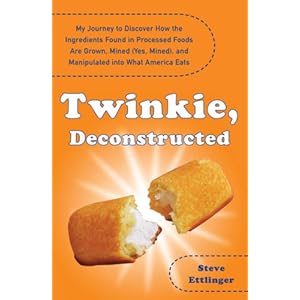
Right now, I'm reading Twinkie, Deconstructed, as part of my Lenten Food Ethics reading. As always, I'll post about it on Friday, but the basic synopsis is this. In an effort to learn more about the myriad ingredients that go into our prepared foods, Steve Ettinger tracks down to their root sources the various ingredients that go into a Twinkie. I've really just started it, so I can't say much more than that, but it looks interesting as a start.
Friday, March 18, 2011
Friday Reviews, 3/18/2011
Holly Black and Justine Larbalestier - Zombies vs. Unicorns:
This was one of the advanced reader copies (ARC) that hapaxnym sent me. She advertised it as "exactly what the title says," which is fair enough. It's a collection of YA short stories, edited by Holly Black and Justine Larbalestier. The back story is that Black and Larbalestier have an ongoing debate about the competing merits of zombies and unicorns - Black is a unicorn booster and Larbalestier is a zombie patriot. In an effort to resolve the debate, they invited several YA authors to write a series of short stories, some featuring zombies, and others featuring unicorns. This is the end result.
What happens when you pack a bunch of YA authors together and tell them to go wild? Mostly teen protagonists, dealing with life, and also unicorns and/or zombies. I picked the book up hoping for something light after the surprisingly heavy Pratchett last week. In the end, I didn't get light. I found the book to be a lot creepier than I had anticipated, especially the unicorn stories, and considerably more thought provoking than I had expected. Several of the stories were real gems: my faves were Maureen Johnson's "Children of the Revolution (z), Diana Peterfeund's "The Care and Feeding of Your Baby Killer Unicorn" (u), Cassandra Clare's "Cold Hands" (z) and Libba Bray's "Prom Night" (z). Scott Westerfeld's "Inoculata" (z) was also interesting. There seem to be more "z"s than "u"s in my favorites, so, perhaps Larbalestier wins?
Some notes on the writing. In general, all of the stories were truly excellent, not just my favorites. The authors clearly had a lot of fun writing the stories for this project. The prose crackles with wit, and the authors have approached their various stories with a lot of thought. In particular, there was an effort to take what could have been a series of cliches and turn it into something fresh. Although both "teams" do a good job in presenting new angles to address unicorns and zombies, I think Team Zombie did a better job overall with that aspect. There are several different types of zombies reflected in the stories, while the unicorns seem largely to be European traditional, despite Black's statements about the various different sorts of unicorns around the world. It would have been nice to see an Indian unicorn, or a Japanese Kirin.
In terms of diversity, the collection is moderately well done as well. There was an interesting range of gender and sexual orientation in the characters, but my overwhelming sense was that the characters were white - there was a Zororastrian in "Prom Night", perhaps she was Middle Eastern?
Final assessment - a well written, fun, witty, sometimes gory (especially the unicorns) collection of stories that many teens will enjoy. I'm not sure I would buy this for myself, but I can definitely think of some teen friends who I would point towards the book.
Lois McMaster Bujold - Cryoburn:
Bujold is widely, and justifiably, regarded as a master of the speculative fiction genre. She writes slick, funny, intelligent, twisty novels that make her readers think deeply. She also, and at the same time (within the same covers, even), writes delightful romance/adventure novels. This is the latest of the Vorkosigan books, and it arrives at a time when her fans were not sure there would BE another Vorkosigan book - there have been dark hints to the effect that Bujold thought she had said everything she had to say about life through Miles Vorkosigan. Seems these rumors were unfounded, because there's this new book.
And what a book! There's a lot in this book. Bujold muses on aging and death and the health care debate in the States, and the financial meltdown, but mostly on aging and death - personal aging, individual death (and what happens after), and also the difficult situation of dealing with aging parents. Oh, and there's a rollicking adventure, a mystery/spy plot, and a pleasant little romance on the side, all wrapped up with Bujold's typical dry wit, and Miles Vorkosigan's outsized antics. For fans of the series, a must read.
I will say this, though, the ending was an emotional kick in the stomach; be prepared.
A must read for fans of Vorkosigan, but perhaps not a great place to start for new comers. Where should one start reading Vorkosigan? Chronologically, Falling Free begins the series - but you don't see those characters again, well, ever. Cordelia's Honor
 * makes some sense, but perhaps the best idea is to start with The Warrior Apprentice
 and then go back to Cordelia's Honor.
This discussion of where to start is not entirely moot, because the hard cover of this book comes with a disc with all the novels on it, for free - new readers can start at a beginning and work their way forward. I'm not sure if this is very interesting marketing ploy, or a potent threat to the possible sale of back catalogues. One of the problems for authors like Bujold, who have written, and are writing, a long series of books, is that new readers will feel lost, and possibly alienated. I know that I strive to locate the first book of a series when I noticed the third or fourth on a new book rack. So, perhaps including the disc is valuable from that point of view, especially as the back catalogue becomes increasingly difficult to find. Still, it feels a little like giving away a library for free along with the purchase of a single book. I don't know, clearly a debate for people more market savvy than myself.
*Cordelia's Honor is an omnibus edition, with two novels in it; Shards of Honor and Barrayar, and tells the story of how Miles' parents met and fell in love.
Barbara Kingsolver - Animal, Vegetable, Miracle
This was the food ethic book that was recommended a couple of weeks ago. It documents a year in the life of Kingsolver's family, as they take a personal challenge to eat only locally produced food for a year. Locally produced, in this case, includes food (vegetables, fruit, chickens, and turkeys) produced on their small farm in Virginia, as well as the 100 to 150 mile radius around the farm. When the family travels, they seek out local food for the area they are in while travelling.
So, this is a book about the localvore movement in the United States. It is also a book about farming on a small scale, or gardening on a large scale. It is a book about paying attention to the basic rhythms and cycles of nature, and about eating consciously; being aware of where the food you are eating came from, and what that entails. The book was informative, possibly to the point of being a little preachy. Kingsolver deflects the preachiness with a healthy dose of familial humor - I especially liked the chapter on turkey mating, and the bit about opening a pumpkin at Thanksgiving, although there were many many nuggets of humor throughout the book. The book was also provocative, although, in my case, preaching to the choir (a little - at the same time, I could easily do a lot better in regards to local eating). I am also compelled to do more with our garden this year (my wife, no doubt, is happy to hear this), and our thoughts about raising some backyard chickens are coming closer to reality, perhaps.
The things I like best about the book - in addition to the humor, I liked the side bars by Kingsolver's husband, and the short essays with recipes by Kingsolver's eldest daughter.
The thing I didn't like about the book - there's a strong thread of gender essentialism throughout. Kingsolver makes statements about how she can do the things she does because she is a housewife - as though the sorts of things she is doing are "women's work." On some level, I think she feels uncomfortable with this as well, as she often hedges these statements with other statements about how this doesn't violate her sense of being a feminist, or of being liberated. The whole thread wasn't enough to poison the book for me, but it irked me a little. Beyond that, it was a fantastic book, and I recommend it highly.
This was one of the advanced reader copies (ARC) that hapaxnym sent me. She advertised it as "exactly what the title says," which is fair enough. It's a collection of YA short stories, edited by Holly Black and Justine Larbalestier. The back story is that Black and Larbalestier have an ongoing debate about the competing merits of zombies and unicorns - Black is a unicorn booster and Larbalestier is a zombie patriot. In an effort to resolve the debate, they invited several YA authors to write a series of short stories, some featuring zombies, and others featuring unicorns. This is the end result.
What happens when you pack a bunch of YA authors together and tell them to go wild? Mostly teen protagonists, dealing with life, and also unicorns and/or zombies. I picked the book up hoping for something light after the surprisingly heavy Pratchett last week. In the end, I didn't get light. I found the book to be a lot creepier than I had anticipated, especially the unicorn stories, and considerably more thought provoking than I had expected. Several of the stories were real gems: my faves were Maureen Johnson's "Children of the Revolution (z), Diana Peterfeund's "The Care and Feeding of Your Baby Killer Unicorn" (u), Cassandra Clare's "Cold Hands" (z) and Libba Bray's "Prom Night" (z). Scott Westerfeld's "Inoculata" (z) was also interesting. There seem to be more "z"s than "u"s in my favorites, so, perhaps Larbalestier wins?
Some notes on the writing. In general, all of the stories were truly excellent, not just my favorites. The authors clearly had a lot of fun writing the stories for this project. The prose crackles with wit, and the authors have approached their various stories with a lot of thought. In particular, there was an effort to take what could have been a series of cliches and turn it into something fresh. Although both "teams" do a good job in presenting new angles to address unicorns and zombies, I think Team Zombie did a better job overall with that aspect. There are several different types of zombies reflected in the stories, while the unicorns seem largely to be European traditional, despite Black's statements about the various different sorts of unicorns around the world. It would have been nice to see an Indian unicorn, or a Japanese Kirin.
In terms of diversity, the collection is moderately well done as well. There was an interesting range of gender and sexual orientation in the characters, but my overwhelming sense was that the characters were white - there was a Zororastrian in "Prom Night", perhaps she was Middle Eastern?
Final assessment - a well written, fun, witty, sometimes gory (especially the unicorns) collection of stories that many teens will enjoy. I'm not sure I would buy this for myself, but I can definitely think of some teen friends who I would point towards the book.
Lois McMaster Bujold - Cryoburn:
Bujold is widely, and justifiably, regarded as a master of the speculative fiction genre. She writes slick, funny, intelligent, twisty novels that make her readers think deeply. She also, and at the same time (within the same covers, even), writes delightful romance/adventure novels. This is the latest of the Vorkosigan books, and it arrives at a time when her fans were not sure there would BE another Vorkosigan book - there have been dark hints to the effect that Bujold thought she had said everything she had to say about life through Miles Vorkosigan. Seems these rumors were unfounded, because there's this new book.
And what a book! There's a lot in this book. Bujold muses on aging and death and the health care debate in the States, and the financial meltdown, but mostly on aging and death - personal aging, individual death (and what happens after), and also the difficult situation of dealing with aging parents. Oh, and there's a rollicking adventure, a mystery/spy plot, and a pleasant little romance on the side, all wrapped up with Bujold's typical dry wit, and Miles Vorkosigan's outsized antics. For fans of the series, a must read.
I will say this, though, the ending was an emotional kick in the stomach; be prepared.
A must read for fans of Vorkosigan, but perhaps not a great place to start for new comers. Where should one start reading Vorkosigan? Chronologically, Falling Free
begins the series - but you don't see those characters again, well, ever. Cordelia's Honor* makes some sense, but perhaps the best idea is to start with The Warrior Apprentice and then go back to Cordelia's Honor.This discussion of where to start is not entirely moot, because the hard cover of this book comes with a disc with all the novels on it, for free - new readers can start at a beginning and work their way forward. I'm not sure if this is very interesting marketing ploy, or a potent threat to the possible sale of back catalogues. One of the problems for authors like Bujold, who have written, and are writing, a long series of books, is that new readers will feel lost, and possibly alienated. I know that I strive to locate the first book of a series when I noticed the third or fourth on a new book rack. So, perhaps including the disc is valuable from that point of view, especially as the back catalogue becomes increasingly difficult to find. Still, it feels a little like giving away a library for free along with the purchase of a single book. I don't know, clearly a debate for people more market savvy than myself.
*Cordelia's Honor is an omnibus edition, with two novels in it; Shards of Honor and Barrayar, and tells the story of how Miles' parents met and fell in love.
Barbara Kingsolver - Animal, Vegetable, Miracle
This was the food ethic book that was recommended a couple of weeks ago. It documents a year in the life of Kingsolver's family, as they take a personal challenge to eat only locally produced food for a year. Locally produced, in this case, includes food (vegetables, fruit, chickens, and turkeys) produced on their small farm in Virginia, as well as the 100 to 150 mile radius around the farm. When the family travels, they seek out local food for the area they are in while travelling.
So, this is a book about the localvore movement in the United States. It is also a book about farming on a small scale, or gardening on a large scale. It is a book about paying attention to the basic rhythms and cycles of nature, and about eating consciously; being aware of where the food you are eating came from, and what that entails. The book was informative, possibly to the point of being a little preachy. Kingsolver deflects the preachiness with a healthy dose of familial humor - I especially liked the chapter on turkey mating, and the bit about opening a pumpkin at Thanksgiving, although there were many many nuggets of humor throughout the book. The book was also provocative, although, in my case, preaching to the choir (a little - at the same time, I could easily do a lot better in regards to local eating). I am also compelled to do more with our garden this year (my wife, no doubt, is happy to hear this), and our thoughts about raising some backyard chickens are coming closer to reality, perhaps.
The things I like best about the book - in addition to the humor, I liked the side bars by Kingsolver's husband, and the short essays with recipes by Kingsolver's eldest daughter.
The thing I didn't like about the book - there's a strong thread of gender essentialism throughout. Kingsolver makes statements about how she can do the things she does because she is a housewife - as though the sorts of things she is doing are "women's work." On some level, I think she feels uncomfortable with this as well, as she often hedges these statements with other statements about how this doesn't violate her sense of being a feminist, or of being liberated. The whole thread wasn't enough to poison the book for me, but it irked me a little. Beyond that, it was a fantastic book, and I recommend it highly.
Monday, March 14, 2011
Monday Library post, 3/14/2011
First up, happy Pi(e) Day! I hope you have all had pie, but if not, there's still time.
Just one book this week:
Jonathan Stroud - The Ring of Solomon
It's a Bartimaeus book, from the perspective of a snarky demon (Bartimaeus) summoned to a Victorian London where demon summoning works, which has some interesting effects on politics and such. Well, the original trilogy was that - this is from rather earlier in Bartimaeus' personal history - a story of King Solomon. Should be amusing.
Post re: food is up here.
Just one book this week:
Jonathan Stroud - The Ring of Solomon
It's a Bartimaeus book, from the perspective of a snarky demon (Bartimaeus) summoned to a Victorian London where demon summoning works, which has some interesting effects on politics and such. Well, the original trilogy was that - this is from rather earlier in Bartimaeus' personal history - a story of King Solomon. Should be amusing.
Post re: food is up here.
Saturday, March 12, 2011
Library Saturday Addenda, 3/12/2011
Had a writing group meeting in a library today. The library happened to have a copy of Barbara Kingsolver's Animal, Vegetable, Miracle , so, based on recommendations, I grabbed it. That will be my food ethics book for next week.
, so, based on recommendations, I grabbed it. That will be my food ethics book for next week.
Friday, March 11, 2011
Friday Review, 3/11/2011
Andrew Lane - The Death Cloud
This is the first of Lane's Young Sherlock Holmes books. The series is approved by the Doyle family, which adds a little something to the experience, perhaps. At any rate, Lane set out to piece together Holmes' adolescence from the hints that Doyle had presented. He writes about the exercise here, and concludes that, for the most part, Holmes' childhood cannot have been a pleasant or comfortable one. Given that, I had expected that this book would be rather more dreadful than it was.
Lane has set himself an interesting challenge - we know, of course, how Holmes turns out; more importantly, we know what skills he has. Doyle, of course, presents us with a preternaturally competent man with a wide array of interests and abilities. Lane has to do two things. First, he has to show us a young Holmes gaining those skills and interests, and second, he has to tell a story worth reading at the same time. I think he succeeds entirely at the first part, and does a pretty good job at the second part, although there are some places where the whole exercise goes somewhat off the rails. Mostly, Holmes inserts himself into situations that he (as an adolescent) has no place inserting himself into. This is, of course, the meat and potatoes of the adolescent detective novel; the Hardy Boys, Nancy Drew, Trixie Belden, the various books of Enid Blyton (The Secret Seven, The Famous Five, and the Adventure books), even Encyclopedia Brown; all hinge on children and teens inserting themselves into matters which are entirely beyond the scope of the average young person. I have no idea why it bothers me here, but it does, a little.
The story turns around the summer that young Sherlock spends with his uncle, since his father has been sent to India with his regiment. Sherlock's brother, Mycroft, newly hired by the British Government, ensures that Sherlock has a tutor for the summer. The tutor, as might be expected, is somewhat non-traditional in his approaches. Against the better judgement of the tutor, Sherlock solves a mystery involving the defense of the realm.
In the end, the whole thing was fun, but not particularly deep.
Grace Pundyk - The Honey Trail
Here's the food ethics book for the week. Pundyk, an Australian free lance writer, sets out to explore the world of honey. Starting in Yemen, she travels to Australia, New Zealand, Borneo, Russia, The United Kingdom, Italy, Turkey, the United States, and China. In each country, she seeks out honey producers and honey sellers. She reveals the twisted history of honey. Honey bees of one sort of another exist natively on every continent except North and South America (the honey produced in the Americas is made by transplanted European bees.) - despite this, Argentina is one of the world's biggest honey producers (only China produces more). Each country makes a slightly, or indeed wildly, different type of honey, depending on the flowers the bees visit, and the species of bees being kept.
The book is fascinating. Honey is deeply complicated. The plant life needed to keep bees is under pressure all over the world - bees are kept in some of the most sensitive ecosystems, from the leatherwood forests of Tasmania (under threat of logging) to the wetlands of Borneo (under threat of being converted into palm oil plantations) to the midwest of the United States (where drought and agricultural monocultures are having a significant and negative impact on bees and honey.) In Australia, Pundyk finds bee keepers who argue that the government is not doing enough to protect forests - and other bee keepers who argue that the government is doing too much. By keeping them out of national parks, the government has significantly impacted the territory of some Australian bee keepers, who must keep moving around the country in order to expose their bees to new flora on a regular basis. In Borneo, she works through a local NGO devoted to turning bee keeping into a viable business in order to keep plantations out of the sensitive land - the NGO works to teach traditional honey hunters more modern techniques, so that fewer bees are killed in the process of harvesting the honey.
Honey is also big business. Pundyk talks a little about the fact that honey has been shipped all over the world since the very earliest of civilizations - there are reports, for instance, of Chinese traders acquiring honey from Borneo, and there are temple paintings of honey trading in Egypt. Honey is, in addition to being a relatively easy to acquire sweetener, highly valued as a medicine. Different honeys are often attributed with different medicinal qualities, and so trade across national borders makes sense.
In modern times, honey remains an important commodity. Pundyk discusses the struggle that smaller producers have in maintaining their local product. For instance, Australia, New Zealand, Europe, and the United States have all raised significant tariff walls against Chinese honey, both because it is much cheaper than locally produced honey, and because there have been some serious problems with chloramphenicol - an antibiotic. Australia and New Zealand both have very stringent import laws - Pundyk is concerned that her honey will be confiscated as she enters these countries (although, actually, it is only as she arrives in Sweden, en route to the UK, that her honey is confiscated. Not, as she feared, because of import laws, but rather as a part of the prohibition against liquids on planes.) Despite this, Australian honey has been found with high levels of nitrofurans - a different antibiotic, used in Argentina, but not in Australia - keeping honey "pure" is harder than it looks. The ban on Chinese honey resulted in the near collapse of one of the major honey producers in the UK - the honey they had been selling was largely Chinese. Other honey companies capitalized.
Argentina ships a vast amount of honey to the US - most of the honey sold in the US is a blend of honey from the US, Canada, and Argentina - but how much of each sort of honey is in the blend is hard to tell. Bee keepers in the US chapter complain about the competition from Argentina - and yet, Pundyk has a surprisingly hard time finding honey, either domestic or imported, in the stores she visits in the US. This leads to a short discussion of food deserts - as she drives across the American South, she is amazed that she sees so little fresh produce on grocery shelves.
In addition to writing about bees, Pundyk writes about herself, about travelling, about finding a home, about falling in love, and blues music, among a great deal else. The books rambles all over the map, just as Pundyk does. At times, this is a little distracting; at other times, it is endearing. In the end, the book is a fascinating meander through a vastly interesting topic, and a nice way to end the Honey Month.
Terry Pratchett - I Shall Wear Midnight
This is the fourth of Pratchett's Tiffany Aching novels. This series is a young adult series, and serves, perhaps, as an independent introduction to Pratchett's Discworld. Tiffany, a young witch, wanders through environments which will be familiar with existing fans of the Discworld novels, but which are presented in a new and fresh way in these books. The books are delightful, regardless of whether you've read any of the rest of Pratchett's work or not - but, there are some grace notes which will enhance the books if you are already a fan. This novel features a cameo appearance by a very old character - Eskarina Smith, the central character of Pratchett's much earlier novel, Equal Rites . If you haven't read the earlier novel, it doesn't matter, but if you have, there's a strong Aha! moment when you recognize Miss Smith, which is nice.
Pratchett plays with metaphors in all of his writing. Here, Pratchett is writing about inclusiveness and interpersonal relations. He is also writing about witch hunts, both literal and figurative - it wouldn't be hard to see this as a novel about the way in which, people of, say, Middle Eastern extraction are treated in Western society. Despite that, the novel is not at all preachy. Instead, it is a romp; entirely delightful. If you are already a fan, this is a must read. If not, I'd say start with The Wee Free Men . My wife contends that the Tiffany Aching books are not necessarily a good place to enter into the Discworld, because Pratchett writes them much differently. Notably, the Tiffany Aching books have chapters, and a relatively small cast of highly developed characters, while the rest of the novels have no chapters, and have vast hordes of characters with somewhat differing levels of development. Pratchett novels are a cumulative thing - the character of, for instance, the witches, evolves quite a lot between Equal Rites (the first appearance of Granny Weatherwax) and Carpe Jugulum (which I reviewed earlier, as part of the vampire thing). The same is true of the members of Ankh Morpork's Night Watch. I think Tiffany Aching is as good a place to start any any other, probably - if you like these, you'll probably find a great deal that you like in the rest of the books.
This is the first of Lane's Young Sherlock Holmes books. The series is approved by the Doyle family, which adds a little something to the experience, perhaps. At any rate, Lane set out to piece together Holmes' adolescence from the hints that Doyle had presented. He writes about the exercise here, and concludes that, for the most part, Holmes' childhood cannot have been a pleasant or comfortable one. Given that, I had expected that this book would be rather more dreadful than it was.
Lane has set himself an interesting challenge - we know, of course, how Holmes turns out; more importantly, we know what skills he has. Doyle, of course, presents us with a preternaturally competent man with a wide array of interests and abilities. Lane has to do two things. First, he has to show us a young Holmes gaining those skills and interests, and second, he has to tell a story worth reading at the same time. I think he succeeds entirely at the first part, and does a pretty good job at the second part, although there are some places where the whole exercise goes somewhat off the rails. Mostly, Holmes inserts himself into situations that he (as an adolescent) has no place inserting himself into. This is, of course, the meat and potatoes of the adolescent detective novel; the Hardy Boys, Nancy Drew, Trixie Belden, the various books of Enid Blyton (The Secret Seven, The Famous Five, and the Adventure books), even Encyclopedia Brown; all hinge on children and teens inserting themselves into matters which are entirely beyond the scope of the average young person. I have no idea why it bothers me here, but it does, a little.
The story turns around the summer that young Sherlock spends with his uncle, since his father has been sent to India with his regiment. Sherlock's brother, Mycroft, newly hired by the British Government, ensures that Sherlock has a tutor for the summer. The tutor, as might be expected, is somewhat non-traditional in his approaches. Against the better judgement of the tutor, Sherlock solves a mystery involving the defense of the realm.
In the end, the whole thing was fun, but not particularly deep.
Grace Pundyk - The Honey Trail
Here's the food ethics book for the week. Pundyk, an Australian free lance writer, sets out to explore the world of honey. Starting in Yemen, she travels to Australia, New Zealand, Borneo, Russia, The United Kingdom, Italy, Turkey, the United States, and China. In each country, she seeks out honey producers and honey sellers. She reveals the twisted history of honey. Honey bees of one sort of another exist natively on every continent except North and South America (the honey produced in the Americas is made by transplanted European bees.) - despite this, Argentina is one of the world's biggest honey producers (only China produces more). Each country makes a slightly, or indeed wildly, different type of honey, depending on the flowers the bees visit, and the species of bees being kept.
The book is fascinating. Honey is deeply complicated. The plant life needed to keep bees is under pressure all over the world - bees are kept in some of the most sensitive ecosystems, from the leatherwood forests of Tasmania (under threat of logging) to the wetlands of Borneo (under threat of being converted into palm oil plantations) to the midwest of the United States (where drought and agricultural monocultures are having a significant and negative impact on bees and honey.) In Australia, Pundyk finds bee keepers who argue that the government is not doing enough to protect forests - and other bee keepers who argue that the government is doing too much. By keeping them out of national parks, the government has significantly impacted the territory of some Australian bee keepers, who must keep moving around the country in order to expose their bees to new flora on a regular basis. In Borneo, she works through a local NGO devoted to turning bee keeping into a viable business in order to keep plantations out of the sensitive land - the NGO works to teach traditional honey hunters more modern techniques, so that fewer bees are killed in the process of harvesting the honey.
Honey is also big business. Pundyk talks a little about the fact that honey has been shipped all over the world since the very earliest of civilizations - there are reports, for instance, of Chinese traders acquiring honey from Borneo, and there are temple paintings of honey trading in Egypt. Honey is, in addition to being a relatively easy to acquire sweetener, highly valued as a medicine. Different honeys are often attributed with different medicinal qualities, and so trade across national borders makes sense.
In modern times, honey remains an important commodity. Pundyk discusses the struggle that smaller producers have in maintaining their local product. For instance, Australia, New Zealand, Europe, and the United States have all raised significant tariff walls against Chinese honey, both because it is much cheaper than locally produced honey, and because there have been some serious problems with chloramphenicol - an antibiotic. Australia and New Zealand both have very stringent import laws - Pundyk is concerned that her honey will be confiscated as she enters these countries (although, actually, it is only as she arrives in Sweden, en route to the UK, that her honey is confiscated. Not, as she feared, because of import laws, but rather as a part of the prohibition against liquids on planes.) Despite this, Australian honey has been found with high levels of nitrofurans - a different antibiotic, used in Argentina, but not in Australia - keeping honey "pure" is harder than it looks. The ban on Chinese honey resulted in the near collapse of one of the major honey producers in the UK - the honey they had been selling was largely Chinese. Other honey companies capitalized.
Argentina ships a vast amount of honey to the US - most of the honey sold in the US is a blend of honey from the US, Canada, and Argentina - but how much of each sort of honey is in the blend is hard to tell. Bee keepers in the US chapter complain about the competition from Argentina - and yet, Pundyk has a surprisingly hard time finding honey, either domestic or imported, in the stores she visits in the US. This leads to a short discussion of food deserts - as she drives across the American South, she is amazed that she sees so little fresh produce on grocery shelves.
In addition to writing about bees, Pundyk writes about herself, about travelling, about finding a home, about falling in love, and blues music, among a great deal else. The books rambles all over the map, just as Pundyk does. At times, this is a little distracting; at other times, it is endearing. In the end, the book is a fascinating meander through a vastly interesting topic, and a nice way to end the Honey Month.
Terry Pratchett - I Shall Wear Midnight
This is the fourth of Pratchett's Tiffany Aching novels. This series is a young adult series, and serves, perhaps, as an independent introduction to Pratchett's Discworld. Tiffany, a young witch, wanders through environments which will be familiar with existing fans of the Discworld novels, but which are presented in a new and fresh way in these books. The books are delightful, regardless of whether you've read any of the rest of Pratchett's work or not - but, there are some grace notes which will enhance the books if you are already a fan. This novel features a cameo appearance by a very old character - Eskarina Smith, the central character of Pratchett's much earlier novel, Equal Rites
. If you haven't read the earlier novel, it doesn't matter, but if you have, there's a strong Aha! moment when you recognize Miss Smith, which is nice.Pratchett plays with metaphors in all of his writing. Here, Pratchett is writing about inclusiveness and interpersonal relations. He is also writing about witch hunts, both literal and figurative - it wouldn't be hard to see this as a novel about the way in which, people of, say, Middle Eastern extraction are treated in Western society. Despite that, the novel is not at all preachy. Instead, it is a romp; entirely delightful. If you are already a fan, this is a must read. If not, I'd say start with The Wee Free Men
. My wife contends that the Tiffany Aching books are not necessarily a good place to enter into the Discworld, because Pratchett writes them much differently. Notably, the Tiffany Aching books have chapters, and a relatively small cast of highly developed characters, while the rest of the novels have no chapters, and have vast hordes of characters with somewhat differing levels of development. Pratchett novels are a cumulative thing - the character of, for instance, the witches, evolves quite a lot between Equal Rites (the first appearance of Granny Weatherwax) and Carpe Jugulum (which I reviewed earlier, as part of the vampire thing). The same is true of the members of Ankh Morpork's Night Watch. I think Tiffany Aching is as good a place to start any any other, probably - if you like these, you'll probably find a great deal that you like in the rest of the books.
Subscribe to:
Posts (Atom)
Subscribe To


 Posts
All Comments
Posts
All Comments