Huh. I'm not sure why I didn't post yesterday.
Three books:
Dave Duncan: When The Saints
Sequel to Speak to the Devil - let's see what the Magnus brothers get up to next.
Tanya Huff: The Heart of Valor
Book 3 of the Confederacy of Valor. More space marines, yay!
Alex Bledsoe - The Hum and the Shiver
This time, I won't lose it under a chair until it's too late to read it before it's due date.
Ahh. That's why I didn't post yesterday - it wasn't a particularly exciting list.
Wednesday, July 25, 2012
Monday, July 23, 2012
Review post, 7/23/2012
It was a good week for reading. Unfortunately, most of the books I read were at least a little disappointing. Sometimes that's how things go.
Four books.
David Crystal - The Story of English in 100 Words
This is more or less what it says on the cover - a discussion of how English evolved as a language as illustrated by 100 separate words. Crystal writes about words, it is what he does, and I'm sure he does it very well. However, for much of this book, I found myself wanting more. The description of the various words, while often interesting and entertaining, left me wanting more - much more in several cases. A single example - the word "Alphabet" included two nuggets of information that didn't go far enough. Nugget the first - the current construction of the alphabet is a fairly recent thing: the 16th century hornbooks which were used to teach children their letters were each a little different in the organisation of their letters.
Nugget the second: in 1817, the Trifler magazine published a poem by Alaric Watts which uses words beginning with all of the letters of the alphabet - one letters per line letter - except J, which was considered a subset of I. Fascinating stuff. But the entry doesn't say when the alphabet attained it's current configuration or when J became it's own letter - I am left wanting a little more. And this was fairly common throughout the work - the entries were witty, but I wanted just a little more. Also, it would have been nice to have been given a clear transition between words instead of the abrupt break that the dictionary format offered. I think the lesson here, as with the 100 most influential animal book I reviewed earlier (not by Crystal) is that 100 is the wrong number of things to use to classify all of a broad class of thing. Fewer things would allow for a deeper discussion of the broad class, and more things would force the presentation of the connections between the various things. Perhaps.
That being said, if you are interested in etymology, but don't really know where to start, perhaps this is a good book to do so.
A.J. Kazinski - The Last Good Man
People are dying all over the world. The deaths seem suspicious. They seem to have similar tattoos on their backs. A detective in Venice suspects a connection. He figures out the spacing between the deaths, both in terms of time and in terms of location, and figures that the next death will be in Venice or in Copenhagen. He also figures out that the people who are dying have one thing in common - they are all "good" people, people who seems naturally selfless. He contacts a counterpart in Copenhagen, who begins investigating. Neils Bentzon, the Danish police negotiator, decides that the people being killed are the 36 Righteous "Men". According to a story in the Talmud, there are 36 Righteous people in each generation who, as long as they are all alive, keep G-d from destroying the world. The 36 don't know who they are, but, Kazinski speculates, they must be naturally good people, inclined to give of themselves to their fellow human beings. If they are dying, this must be a bad thing. Bentzon sets out to stop the next death.
This book was a really big deal in Denmark in 2010. I can only conclude that the Danes have very peculiar literary tastes, because the book is something of a dog's breakfast, frankly. There are odd mathematics and unusual religious things sprinkled throughout. There's a tiny little subplot about out of body near death experiences that doesn't really seem to add anything to the overall work. Kazinski adds the twist that the Righteous 36 are physically connected to their "sector" of the globe (which corresponds, naturally enough, to a chunk of the pre-continental drift Pangeaic continent) and, if they travel beyond their "sector", they become ill. This is all a little messy, but manageable. I read Umberto Eco, after all. My big problem is that the novel really doesn't resolve well, at all. Does Bentzon get back together with his estranged wife, or does he stay with the estranged wife of a Danish mathematician who helps him out? Why were the 36 being killed? Kazinski suggests that this isn't the first time this has happened - is this a "natural" process? If so, does that mean that the murderer is God? Because, if so, the motive is "because I'm a big jerk," which is unsatisfying.
There's a lot of potentially good stuff in this mess of a novel. I'd love to find out that something was lost in translation. I fear that this is not the case. I suspect that it's just a disappointing novel.
Dave Duncan - Speak to the Devil
This one was NOT a disappointment at all. I love Duncan. His characters have such a vibrancy, and such compelling flaws - I just want to gobble these books up. I'll be grabbing book 2 at the library tomorrow.
Set in a fictitious middle-European country, in the late 18th century, this is the story of a family of cavaliers. These young men are known within their nation for their swordsmanship, for their loyalty, for their fearless recklessness, and for their tendency to "Speak" to voices. The Speakers claim that the voices are saints (the voices claim likewise). The Church claims that the voices are devils or the Devil. Hence the title.Either way, Speaking allows Speakers to have a profound and supernatural effect on their surroundings - it's magic, or its a miracle, but it tends to be big, and it tends to be noticeable.
Anton Magnus is asked by the chief adviser to the king of Jorgary to assume the command of a border fort, and to prevent an invasion from outside, possible aided by a Speaker. Anton's brother, Wolfgang, is, secretly (or, perhaps, not so secretly) a Speaker, and he agrees (reluctantly) to help. Anton and Wolfgang manage to get matters under control, but Wolfgang falls in love with the woman to whom Anton is supposed to get married, and things get delightfully complicated from there.
Duncan revels in twisting a plot and twisting a plot and twisting a plot until the reader isn't sure if the plot is coming or going. He likes to stab his characters in the back (although not quite as often or as roughly as George Martin, for instance - it's generally safe to become attached to Duncan's characters), and he likes to tweak historical settings just a little (he also likes to include an historical note, and you KNOW I like those). Duncan likes big heroic swashbuckling characters with huge glaring flaws and blind spots, and this book is no exception to this rule. Anton's view of Anton and the view that the rest of the world has about Anton are completely different, and the gap between these two views really provides the humor in this book.
So. It's a big, comic, tragic novel with swords and canons and love and betrayal and magic - delicious - but it doesn't really end solidly, which is the other reason I'll be getting book two tomorrow. So, not disappointed, but a little unsatisfied.
Stephen Segal, ed - Geek Wisdom
It's a cute concept - take a series of geeky quotes (from comics, movies, television, etc) and turn them into a system of wisdom - almost a religion, really. Segal and his co-writers do a pretty good job of expanding the various sayings into broader examinations of the world, and the role of the geek within the world. Again, as with Crystal's word book, I wanted a little more - a little more structure, perhaps, or a little more application. A little more glossing of the text. More discursive footnotes, maybe. It was a cute idea - it could have been expanded and turned into a great idea. I did, however, add The A-Team and Quantum Leap to my Netflix instant view queue. So, not a total loss.
Four books.
David Crystal - The Story of English in 100 Words
This is more or less what it says on the cover - a discussion of how English evolved as a language as illustrated by 100 separate words. Crystal writes about words, it is what he does, and I'm sure he does it very well. However, for much of this book, I found myself wanting more. The description of the various words, while often interesting and entertaining, left me wanting more - much more in several cases. A single example - the word "Alphabet" included two nuggets of information that didn't go far enough. Nugget the first - the current construction of the alphabet is a fairly recent thing: the 16th century hornbooks which were used to teach children their letters were each a little different in the organisation of their letters.
 |
| A hornbook, which is neither a horn, nor a book. |
Nugget the second: in 1817, the Trifler magazine published a poem by Alaric Watts which uses words beginning with all of the letters of the alphabet - one letters per line letter - except J, which was considered a subset of I. Fascinating stuff. But the entry doesn't say when the alphabet attained it's current configuration or when J became it's own letter - I am left wanting a little more. And this was fairly common throughout the work - the entries were witty, but I wanted just a little more. Also, it would have been nice to have been given a clear transition between words instead of the abrupt break that the dictionary format offered. I think the lesson here, as with the 100 most influential animal book I reviewed earlier (not by Crystal) is that 100 is the wrong number of things to use to classify all of a broad class of thing. Fewer things would allow for a deeper discussion of the broad class, and more things would force the presentation of the connections between the various things. Perhaps.
That being said, if you are interested in etymology, but don't really know where to start, perhaps this is a good book to do so.
A.J. Kazinski - The Last Good Man
People are dying all over the world. The deaths seem suspicious. They seem to have similar tattoos on their backs. A detective in Venice suspects a connection. He figures out the spacing between the deaths, both in terms of time and in terms of location, and figures that the next death will be in Venice or in Copenhagen. He also figures out that the people who are dying have one thing in common - they are all "good" people, people who seems naturally selfless. He contacts a counterpart in Copenhagen, who begins investigating. Neils Bentzon, the Danish police negotiator, decides that the people being killed are the 36 Righteous "Men". According to a story in the Talmud, there are 36 Righteous people in each generation who, as long as they are all alive, keep G-d from destroying the world. The 36 don't know who they are, but, Kazinski speculates, they must be naturally good people, inclined to give of themselves to their fellow human beings. If they are dying, this must be a bad thing. Bentzon sets out to stop the next death.
This book was a really big deal in Denmark in 2010. I can only conclude that the Danes have very peculiar literary tastes, because the book is something of a dog's breakfast, frankly. There are odd mathematics and unusual religious things sprinkled throughout. There's a tiny little subplot about out of body near death experiences that doesn't really seem to add anything to the overall work. Kazinski adds the twist that the Righteous 36 are physically connected to their "sector" of the globe (which corresponds, naturally enough, to a chunk of the pre-continental drift Pangeaic continent) and, if they travel beyond their "sector", they become ill. This is all a little messy, but manageable. I read Umberto Eco, after all. My big problem is that the novel really doesn't resolve well, at all. Does Bentzon get back together with his estranged wife, or does he stay with the estranged wife of a Danish mathematician who helps him out? Why were the 36 being killed? Kazinski suggests that this isn't the first time this has happened - is this a "natural" process? If so, does that mean that the murderer is God? Because, if so, the motive is "because I'm a big jerk," which is unsatisfying.
There's a lot of potentially good stuff in this mess of a novel. I'd love to find out that something was lost in translation. I fear that this is not the case. I suspect that it's just a disappointing novel.
Dave Duncan - Speak to the Devil
This one was NOT a disappointment at all. I love Duncan. His characters have such a vibrancy, and such compelling flaws - I just want to gobble these books up. I'll be grabbing book 2 at the library tomorrow.
Set in a fictitious middle-European country, in the late 18th century, this is the story of a family of cavaliers. These young men are known within their nation for their swordsmanship, for their loyalty, for their fearless recklessness, and for their tendency to "Speak" to voices. The Speakers claim that the voices are saints (the voices claim likewise). The Church claims that the voices are devils or the Devil. Hence the title.Either way, Speaking allows Speakers to have a profound and supernatural effect on their surroundings - it's magic, or its a miracle, but it tends to be big, and it tends to be noticeable.
Anton Magnus is asked by the chief adviser to the king of Jorgary to assume the command of a border fort, and to prevent an invasion from outside, possible aided by a Speaker. Anton's brother, Wolfgang, is, secretly (or, perhaps, not so secretly) a Speaker, and he agrees (reluctantly) to help. Anton and Wolfgang manage to get matters under control, but Wolfgang falls in love with the woman to whom Anton is supposed to get married, and things get delightfully complicated from there.
Duncan revels in twisting a plot and twisting a plot and twisting a plot until the reader isn't sure if the plot is coming or going. He likes to stab his characters in the back (although not quite as often or as roughly as George Martin, for instance - it's generally safe to become attached to Duncan's characters), and he likes to tweak historical settings just a little (he also likes to include an historical note, and you KNOW I like those). Duncan likes big heroic swashbuckling characters with huge glaring flaws and blind spots, and this book is no exception to this rule. Anton's view of Anton and the view that the rest of the world has about Anton are completely different, and the gap between these two views really provides the humor in this book.
So. It's a big, comic, tragic novel with swords and canons and love and betrayal and magic - delicious - but it doesn't really end solidly, which is the other reason I'll be getting book two tomorrow. So, not disappointed, but a little unsatisfied.
Stephen Segal, ed - Geek Wisdom
It's a cute concept - take a series of geeky quotes (from comics, movies, television, etc) and turn them into a system of wisdom - almost a religion, really. Segal and his co-writers do a pretty good job of expanding the various sayings into broader examinations of the world, and the role of the geek within the world. Again, as with Crystal's word book, I wanted a little more - a little more structure, perhaps, or a little more application. A little more glossing of the text. More discursive footnotes, maybe. It was a cute idea - it could have been expanded and turned into a great idea. I did, however, add The A-Team and Quantum Leap to my Netflix instant view queue. So, not a total loss.


Tuesday, July 17, 2012
Library Post, 7/17/2012
Friends, it is hot. It is miserably hot. Ok, I'm whining, I know it's hotter further south, but I moved north specifically to escape the hot, and clearly I didn't go far enough. But, you know who has free air conditioning? Libraries. Which is awesome. And, since Kid 1 is enrolled in three separate reading programs, we get to visit three libraries as week. Where there is air conditioning. Ahhhhh. Maybe, Thursday, we will go to a bookstore or something like that. Or swimming. Perhaps swimming. We shall see.
Anyway, three books this week:
Andrew Blum - Tubes: A Journey to the Center of the Internet
Blum travels to the places around the world where the physical components that make up the internet exist. This could be interesting, it could be dreadfully dull - we'll find out!
John Scalzi - Redshirts
This is trending hot right now, Scalzi has just finished a book promo tour, including a spot on National Public Radio. His premise - what if we told a Star Trek-esque story entirely from the point of view of those hapless redshirts who we all know will die before the end of the episode? And, what if they KNEW they were redshirts? And, what if the fate of the universe hinged on the redshirts being the heroes? I'm really looking forward to this one.
Brandon Sanderson - Mistborn
This has been recommended to me several times, and it probably reflects a serious gap in my genre knowledge. The sequels looks delightfully steampunk, so I hunted down the first one. It looks hefty, but that's never stopped me before.
Monday, July 16, 2012
Monday Reviews, 7/16/2012
Bob Tarte - Kitty Cornered
People who read non-fiction books about other people living with animals have, I think, a right to expect certain things. They should expect some humorous stories about the animals in question acting in odd ways. They should expect some humorous stories about the people in question acting in odd ways. They should expect at least one trip to a veterinarian. They should expect at least one point at which it is not clear if (one of) the animal(s) in question will survive to the end of the book, which should be resolved quickly. If that point comes early in the book, probably the animal will live - if later, probably not. Unless the book is about struggling to nurse an injured animal back to health, in which case the resolution will take some time, and could still easily go either way. Some lesson should be drawn about human nature, based on the interaction between the animal(s) and the human. If that is what you are expecting from Bob Tarte's book, you will almost certainly be satisfied. The humor is a little dry, and it took me a bit to tune into it, but otherwise, Tarte hits all of the high points in the check list.
I should also say that Tarte's story feels very true, and it should feel true to any other cat people. He has five cats; we have three, but the differences are a matter of scale rather than type. Cat people are a little crazy about their cats. For instance, we struggle with their independence while considering that to be a feature. We keep the cat which lives under the bed, even though said cat doesn't actually DO any of the things that make cats pleasant - sit on your lap, for instance, or purr nicely. When my 15 pound beast of a cat flops on my lap in the 90 degree living room, I accept that as affection. Tarte describes life with cats. It will be familiar to others who have experienced life with cats. Again, if that's what you are looking for when you open the book, you won't have any problems.
In conclusion, a picture of my cat:

Ally Carter - Cross My Heart and Hope to Spy
The second of the Gallagher Girl novels. Girls' boarding school. Spies. Boys. The interaction of these three things. A delightful, if somewhat fluffy, novel - highly enjoyed. I do wonder, however, if all of the novels will end with what initially seems to be a "mission", but which turns out to be something else - I hope not, that would get predictable pretty quick.
I really like Carter's use of idiom; the way her teen characters talk is amusing, and feels authentic. I also like the way that the girls switch, effortlessly, between teen and spy in their outlook on life, and how the two outlooks often overlap - getting the kiss and getting the documents that will bring down an enemy government - equally important in the minds of the characters. Again, that feels authentic.
Isabel Cooper - Lessons After Dark
At least one of the purchasing agents at my local library shares my taste in books. (Actually, since I know that the children and teens librarian is a big fan of graphic novels, and that she often buys the sort of thing I like to read in that vein, there are probably two purchasing agents who share my tastes). This is the sequel to No Proper Lady, and it is really fun.
One of the problems that an author runs into when writing a sequel is where to place the emphasis. Obviously, you want to include the characters from the first book, because otherwise it isn't a sequel - what's the point? And yet (and this is especially true in a romance novel like this one), those characters have already had their story. You can't make them fall in lust/love/bed again, and expect it to work on the same level. So, sometimes its the siblings, or the best friend, or, in this case, the teachers who the characters have hired to train the magically empowered students at their manor house. That's right - this book is X-Men meets Harry Potter - a school for "gifted" students (in the country side of England), where the "gifts" in question are magical in nature. Olivia Brightmore is hired to teach ritual magic, and Gareth St. John has been hired as a school doctor - magic often results in injuries, and St.John has the added bonus of being magically gifted himself.
Plot wise, this one takes a little while to get going - the antagonist is a little nebulous, and so the external conflict doesn't really arise until the last 1/3 or 1/4 of the book. Which is fine, because this is a romance novel, and the tension we, the readers, are really interested in is the sexual tension between the two leads. This book has sexual tension to spare. Olivia is a widow, St.John suspects that she's a con artist, there's mutual attraction, and mutual distrust (hard to trust a man who seems intent on exposing you as a fraud) - it's good stuff. Also, Cooper writes a very sex positive romance novel - Brightmore is a widow; she's not a stranger to sex, she knows what she likes, and she doesn't feel guilty about getting it. St. John doesn't trust Brightmore, but he also doesn't think less of her for the fact that she enjoys sex - no shrinking virgins or rape fantasies here, nicely done. Additionally, Cooper avoids the over use of the word "cock" in this book, without resorting to the absurdities of euphemisms that are so common in romance - "his tenderness", "her flower", etc etc. No, there are no vulgarities either. Also well done.
When the plot DOES pick up, it picks up in a big way. There are ghosts, and a demon, and maybe another demon, and curses, and Jack the Ripper makes a cameo appearance (well, ok, there's a mention of the Ripper murders, because it gets Mr. and Mrs. Grenville out of the house at an appropriate moment - Jack doesn't really play a role in this novel) - all sorts of good stuff, in terms of plot.
So. A good romance, a good paranormal story, some good regency stuff - lovely. Can't wait for book 3 - I'm expecting, as possible romantic main characters, either Miss Grenville, (sister of the male lead in book 1 - she's away on the Continent in this book, which means that book 3 could be concurrent, which would be fun), Miss Charlotte Woodwell (she talks to the animals), or possibly Michael Waite (he makes it rain) and either Miss Elizabeth or Miss Rosemary Talbot (daughters of the vicar who lives down the road). Hmmm. Lots of potential for sequels - the anticipation!
Wednesday, July 11, 2012
Library Post, 7/11/2012
For those of you sufficiently blessed to have access to a 7-11, I hope you got your free Slurpie today. We, alas, are not so blessed. :(
So, I did go to the library yesterday. It was a whirlwind trip, because Kid 1 has camp until 4, and Kid 2 had a doctor's appointment at 5:30 (just a routine checkup), and it takes a certain amount of time to get from camp to the library and etc. Anyway, I didn't get any books yesterday. However, Kid 1 is also enrolled in three separate library summer reading programs - the joys of homeschooling! - which means we need to visit three different libraries over the course of the week in order to enter things and fill out things and get books so she can meet her reading quotas and such. So, today, I got two books:
Daniel Abraham - The Dragon's Path
This could easily be pretty straightforward epic fantasy, but one of the characters works for a bank smuggling gold from both sides of a conflict. That, alone, is enough to intrigue me - if the economics and politics are good, the book will be worth reading. If not, I probably won't finish it. We shall see.
Ha-Joon Chang - 23 Things They Don't Tell You About Capitalism
Speaking of economics... Chang is an economist at the University of Cambridge. This book purports to explain why the current economic muddle is the way it is and how to fix it. Chang espouses a regulated capitalism, which means much of this will be preaching to the choir for me - I'm hoping the book will rise about "talking points for refuting idiots on the internet", especially since Kathryn Shulz suggests that arguing with people who are wrong on the internet is probably not all that useful.
Tuesday, July 10, 2012
Reviews, 7/10/2012
Kid 1 is in camp this week, so I'm at home with Kid 2. This doesn't explain or excuse not posting yesterday, I'm just saying.
Anyway, two books:
Kathryn Shulz - Being Wrong
A brilliant book. We are all wrong. Some of us are wrong more often than others, but none of us are infallible. This book looks at why that is, and then discusses why we think this is a bad thing, and finally explains why we're wrong to feel that being wrong is a bad thing.
Shulz writes in a breezy conversational style, using lots of footnotes-as-asides, and packing a lot of fascinating stuff into the endnotes for foks who want the story but not the details. This makes the book easily accessible to the layman, but also satisfying to the slightly more discerning reader.
Shulz opens each chapter with a short story of someone being wrong, and then she unpacks the story to illustrate her broader point in the chapter. This contributes to the conversational style - almost like a cocktail party, where the quirky story opens some more generalized discussion. When things sag a bit, Schulz sneaks in another quirky story, and peps things up. This is altogether delightful.
Shulz's argument goes like this: We are all wrong, often. We cannot know when we are wrong, we can only know when we have been corrected - it is logically false to say "I am wrong," because once we recognize that the thing we were saying was wrong, we are no longer wrong. We are wrong because our senses fool us, because our brains work in a particular way, because our society has convinced us of certain things, because we want to fit in with our friends, because our views about ourselves, the universe, and our position within the universe change as we age. We think this is a bad thing because society has taught us that, and because being corrected feels bad. But, out of wrongness comes art and science and progress and all things that make us human - animals are never wrong, because their brains don't work that way. So, we should embrace our wrongness, because it is the way that we express our humanity. This is a remarkably freeing philosophy, and Shulz presents it compellingly. This book should be required reading.
David Kowalski - The Company of the Dead
Wow. This was a really good book, and a surprisingly quick read. Kowalski is playing with the very idea of alt-history by focusing on the world that a minor change in history creates, and on efforts to fix that minor change. It's a time travel novel, which means lots and lots of paradox and plot twists that I'll try very hard not to give away. Someone from now, through accidental use of a time machine, ends up in 1911, and decides to fix things, starting with saving the Titanic. This results in an entirely new world which Kowalski unfolds deliciously over nearly 800 pages. In the new world, the US didn't enter WWI, so Germany won. Shortly thereafter, Texas secedes, and takes many of the Southern states along for the ride. This time, the Union doesn't intervene, because (as one of the characters muses) they don't think they can win. By 1999, Imperial Germany and Imperial Japan are the two big superpowers, with Russia loosely allied to Germany, along with France, England, and the Confederacy. The Union is partially occupied by Japan, which is loosely allied with Imperial Mexico. There's a map, which is actually kinda helpful. When a diary of the original time traveler turns up, a group of Confederate spies decide to go back and fix what he changed, because the situation in alt-1999 is hugely unstable.
The book is action packed, with aerial combat, giant floating balloons (not quite steampunk - diesel punk, perhaps? History-Punk, maybe), tanks, spies, secret plots within plots, backstabbing, atomic bombs - all manner of juicy good stuff. The military fiction stuff is outside of the control of the protagonists, so none of the whole top down, bottom up stuff that I mentioned a couple of weeks ago - an elegant solution. A satisfying spy story, and, as I said, lots and lots and lots of lovely twists in the plot of the sort that only time travel can allow. The action continues at a breathless pace throughout the novel, right up to the very end, which satisfies completely. A marvelous first book, recommended without reservation - except, what on earth can Kowalski do to follow up?
Thursday, July 5, 2012
Welcome to New People
So, Pamela Ribon linked to my review of her book earlier this week, which is a surprisingly decent thing of her to do. And, according to my stats, some people have wandered over from her link, which is also a surprisingly decent thing for them to do. So, I'm reprising my Welcome post for them:
I'm glad you've stopped in! Please, enjoy a virtual plate of brownies (I almost said cookies - but those are something different on the internet, aren't they?)
I suggest that, if you are interested in a decent taste of the blog, you take a look at the Honey Month posts (they're tagged - the tag cloud is just visible on the right of the post) and, possibly, the Hickey of the Beast posts (also tagged) - both offer a coherent thread that is reasonably easy to follow (I think).
Other thoughts. The post recommendations that pop up at the bottom of my posts are ... odd. I think my style of writing doesn't work well with that sort of thing. I will warn you that I'm not as regular a poster as I sometimes hope to be, but you are generally safe in expecting at least two posts a week. Comments posted via the RSS feed frequently don't show up on the main site (although I see them in my e-mail), and, thus far, I have been too lazy/busy to do anything about that. I would love it if people were to suggest books for me to look at.
I'm glad you've stopped in! Please, enjoy a virtual plate of brownies (I almost said cookies - but those are something different on the internet, aren't they?)
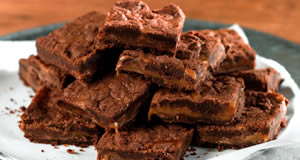 |
| On the internet, brownies have no calories or allergens |
Other thoughts. The post recommendations that pop up at the bottom of my posts are ... odd. I think my style of writing doesn't work well with that sort of thing. I will warn you that I'm not as regular a poster as I sometimes hope to be, but you are generally safe in expecting at least two posts a week. Comments posted via the RSS feed frequently don't show up on the main site (although I see them in my e-mail), and, thus far, I have been too lazy/busy to do anything about that. I would love it if people were to suggest books for me to look at.
Subscribe to:
Posts (Atom)
Subscribe To


 Posts
All Comments